Restaurant Revenue Lost to Language Barriers: The Hidden Cost
A couple sits down at your restaurant. They've found you on Google Maps, checked your rating, and walked in. They pick up the menu, look at it for a long time, then point at two items and hold up two fingers. They order two mains, no starters, no drinks beyond water, no dessert. They pay, leave a polite nod, and they don't come back.
This scenario plays out thousands of times a day in restaurants across tourist-heavy cities. The diners weren't unhappy. They just couldn't read the menu.
The restaurant language barrier revenue impact is rarely tracked because it looks like a normal transaction. No complaint was made. No meal was returned. But the average spend was half of what it could have been, and the repeat visit that a great dining experience would have generated never happens.
How Language Barriers Reduce Average Spend
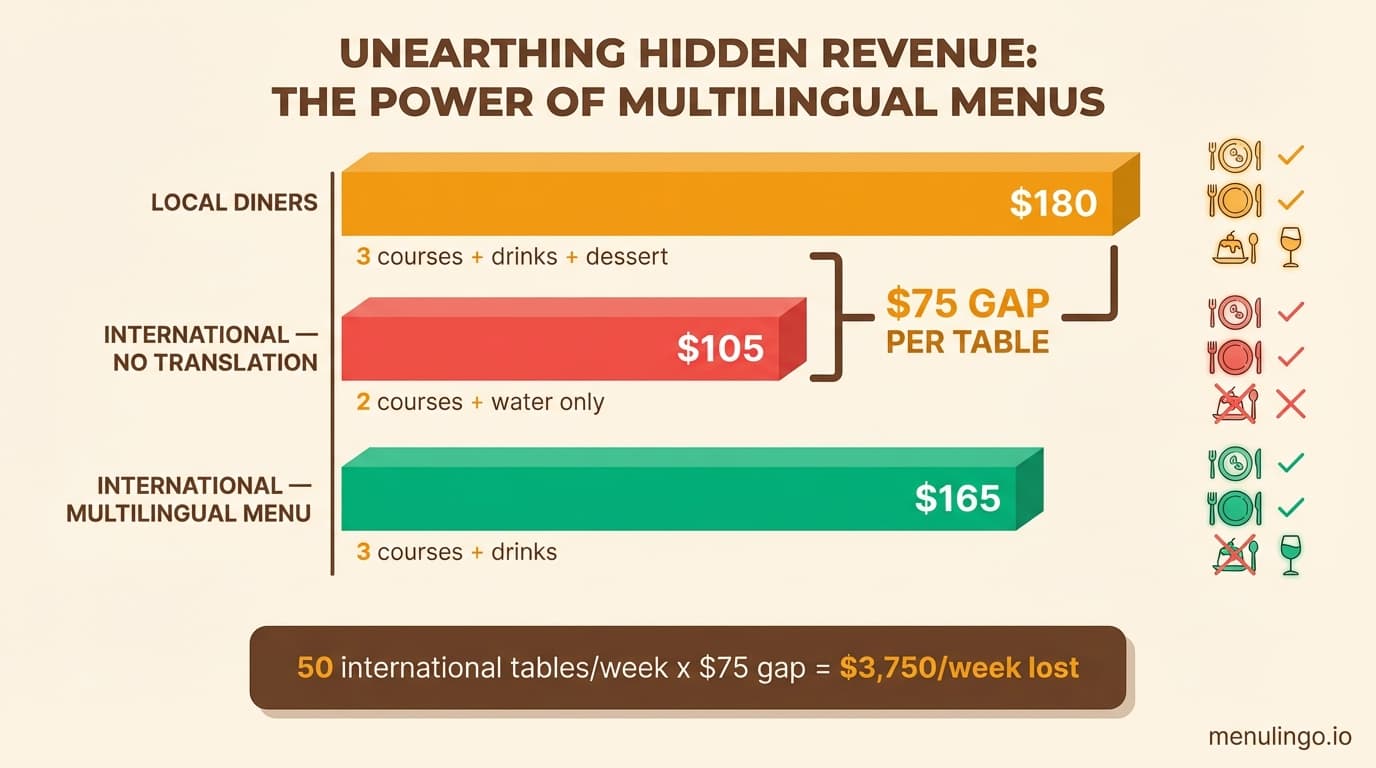
When a diner can't read the menu, their ordering behaviour changes in predictable ways. Each of these changes directly reduces the revenue your restaurant earns from that table.
Conservative Ordering
Diners who can't read descriptions default to dishes they recognise — typically the simplest, lowest-priced items. A diner who would happily order your $38 slow-braised lamb shoulder if they understood what it was will instead point at the $22 pasta, because "spaghetti" is a word they know.
This isn't a communication preference. It's risk avoidance. Ordering food you can't identify is a gamble most people won't take, especially when they're spending money in an unfamiliar city.
Lost Upsells and Add-Ons
The revenue mechanics of a successful restaurant depend heavily on upsells. Starters, sides, premium drinks, desserts — these add-ons can represent 30-40% of total spend per table.
But upselling requires comprehension. A waiter describing the chef's special truffle butter to accompany the steak only works if the diner understands the description. When the diner doesn't speak the language, most upsell conversations simply don't happen. The waiter, sensing the communication difficulty, doesn't attempt them.
The result: international diners order fewer courses, fewer sides, and fewer premium options. Not because they don't want them — because they don't know they exist.
Drinks Revenue Drop
Drinks are where restaurants often achieve their highest margins. But drinks menus, wine lists, and cocktail descriptions rely heavily on evocative language — "notes of blackcurrant and cedar" or "a crisp, mineral finish." These descriptions are meaningless to someone who doesn't speak the language.
International diners at English-only restaurants commonly default to beer, house wine, or water. The $18 cocktail and the $65 bottle from your curated wine list go unordered — not because the diner wouldn't appreciate them, but because the menu didn't communicate their value.
The Repeat Visit That Never Happens
Revenue from a single visit is only part of the calculation. For restaurants in tourist areas, word-of-mouth recommendations among tourist communities drive significant traffic. A Chinese tourist who has a great dining experience tells their travel group, posts on Xiaohongshu (China's dominant lifestyle platform), and reviews you on Dianping or TripAdvisor.
A Chinese tourist who had a confusing, limited experience tells nobody. Or worse, they describe the restaurant as unwelcoming — not because the staff were rude, but because the inability to communicate felt exclusionary.
Restaurants that provide multilingual menus remove this friction entirely. The diner reads the full menu in their language, understands every dish, orders with confidence, and leaves with a positive impression worth sharing. The downstream revenue from that positive experience — recommendations, reviews, repeat group visits — compounds over time.
Quantifying the Gap
Precise figures vary by market, cuisine, and tourist profile, but the patterns are consistent across industry data:
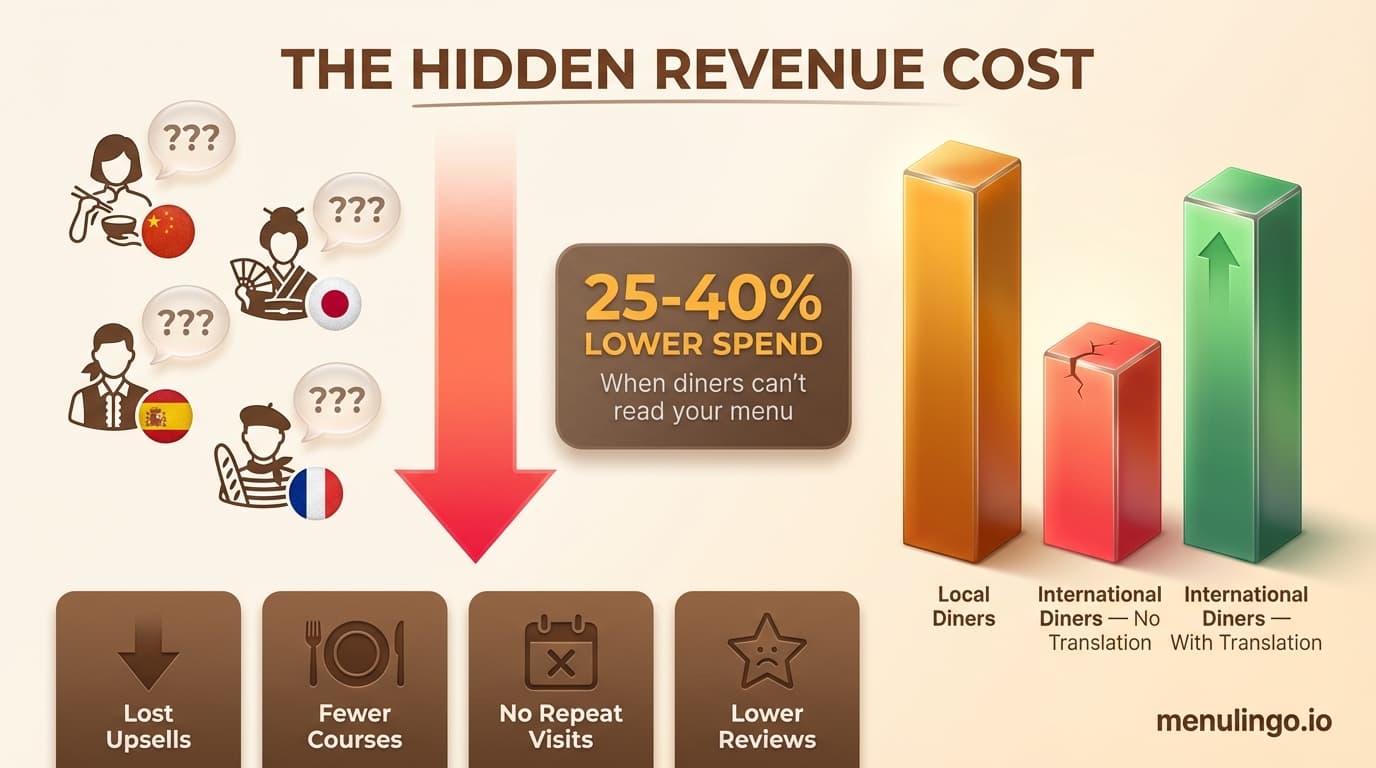
Average spend gap. International diners at restaurants without multilingual menus typically spend 25-40% less per head than comparable local diners, according to hospitality industry research. The gap is largest in restaurants with complex or unfamiliar cuisine and smallest in casual dining with globally recognisable dishes.
Course reduction. Local diners at mid-range restaurants typically order 2.5-3 courses. International diners at the same restaurant, without a language solution, average 1.5-2 courses. That half-course difference, multiplied across dozens of international tables per week, represents substantial lost revenue.
Group spend differential. For group bookings (tour groups, conference attendees), the language barrier effect multiplies. If one person at a table of eight can translate the menu, the table performs closer to local averages. If nobody can, the entire table orders conservatively. A group of eight ordering two courses instead of three represents a revenue difference of $150-300 in a single sitting.
Which Restaurants Are Most Affected?
The revenue impact of language barriers is highest for restaurants with one or more of these characteristics:
Tourist-area location. Restaurants near landmarks, hotels, cruise terminals, airports, and conference centres see the highest proportion of international diners. In cities like Sydney, London, New York, Barcelona, or Tokyo, international diners can represent 30-50% of covers during peak tourist season.
Complex or regional cuisine. Restaurants serving cuisines with unfamiliar terminology — French fine dining, regional Japanese, modern Australian, Peruvian — face the biggest comprehension gap. A diner who doesn't speak English may not recognise "ocean trout crudo with finger lime and shiso" but would happily order it if they understood the description in their language.
Higher price points. The absolute revenue impact grows with price. A $15 per-head spend gap at a casual cafe is $60 per four-top. That same 25% gap at a fine dining restaurant charging $80 per head becomes $80 per four-top. Multiply by tourist-season volume and the numbers become significant.
Drinks-focused venues. Cocktail bars, wine bars, and restaurants where beverages represent a large share of revenue are disproportionately affected. Drink descriptions are among the hardest menu items to understand in a foreign language.
The Allergen Communication Problem Compounds It
Language barriers don't just affect ordering behaviour. They affect safety. When a diner can't read the menu, they also can't read the allergen information.
A diner with a shellfish allergy who speaks limited English might avoid the entire seafood section of the menu as a precaution — even though several seafood dishes on your menu don't contain shellfish. That's a direct revenue loss: a diner who wanted to spend more but couldn't take the risk.
Worse, a diner who can't read allergen labels might order something unsafe. The real cost of allergen mistakes extends to legal liability, reviews, and insurance — all amplified when the root cause is a language barrier.
AI-powered allergen detection combined with multilingual display addresses both problems simultaneously. The diner reads allergen information in their own language, filters out unsafe dishes, and orders with confidence. Revenue goes up because safe diners spend more freely.
Why Google Translate Isn't the Answer
Some restaurants attempt to address language barriers by running their menu through Google Translate or a similar machine translation tool. The intention is good. The results, unfortunately, are often counterproductive.
Generic translation tools don't understand food terminology. "Char-grilled spatchcock" might translate literally as "burnt flattened rooster." "Twice-cooked pork belly" could become "pork stomach cooked two times." These mistranslations don't just fail to communicate — they actively discourage ordering.
Culinary translation requires context that generic tools lack. A "reduction" in a kitchen is a sauce technique, not a discount. "Confit" is a cooking method, not a preserved object. "Jus" is not juice. Every cuisine has dozens of these terms, and each one is a potential mistranslation that confuses the diner or misrepresents the dish.
Professional menu translation — whether by a human translator or an AI system trained specifically for culinary contexts — preserves the meaning and appeal of each dish description. The difference between a good translation and a bad one is often the difference between a $45 order and a $22 order.
The Multiplier Effect of Multilingual Menus
When a restaurant adds multilingual menu support, the revenue impact extends beyond the direct spend increase from international diners.
Higher average spend. International diners who can read the full menu in their language order like local diners — full courses, add-ons, premium drinks. The 25-40% spend gap narrows or closes entirely.
Increased tourist traffic. Restaurants that appear multilingual-friendly in Google Maps listings, TripAdvisor reviews, and travel-community recommendations attract more international diners. Being known as "the restaurant where they have a Chinese menu" or "they have menus in Japanese" is a competitive advantage in tourist areas.
Better reviews. Diners who have a comfortable, comprehension-rich experience leave better reviews. Better reviews drive more traffic. This creates a positive feedback loop that compounds over months and years.
Allergen safety. Multilingual allergen information reduces the risk of allergen incidents with international diners — protecting both the diner and the restaurant from the costs of a mistake.
Staff efficiency. When the menu communicates for itself, staff spend less time on awkward pointing-and-gesturing interactions and more time on genuine hospitality. Table turn times can improve because ordering is faster.
How to Calculate Your Restaurant's Language Barrier Cost
Here's a rough framework to estimate what language barriers might be costing your restaurant:
Step 1: Estimate your international diner percentage. Ask your front-of-house team — they'll have a good sense. In a tourist area, 20-40% is common during peak periods.
Step 2: Estimate the average spend gap. Compare what your typical local four-top spends versus what a typical international four-top spends. If you track this in your POS system, use real data. If not, 25-30% less is a reasonable estimate based on industry patterns.
Step 3: Multiply. If you serve 50 international diners per week with an average spend gap of $15 per head, that's $750 per week — $39,000 per year in unrealised revenue.
Step 4: Add the indirect costs. Lower average reviews from international visitors, missed upsell opportunities, allergen communication risks, and the staff time spent on language-barrier interactions.
For most restaurants in tourist-adjacent areas, the total cost of language barriers substantially exceeds the cost of providing multilingual menus.
What a Multilingual Menu Solution Looks Like
The most effective approach for restaurants serving international diners combines several elements:
QR code access. A QR code at the table that opens the menu on the diner's phone. No app download, no special hardware. The diner scans, selects their language, and reads the full menu.
Professional translation. Menu items, descriptions, and allergen information translated by an AI system trained for culinary contexts — not generic machine translation. The translation preserves the appeal and accuracy of each dish description. Learn how AI menu translation works for a deeper look at the technology.
Allergen integration. Allergen labels displayed in the diner's language, with filtering available. A diner with a nut allergy reads "contiene frutos secos" in Spanish or the equivalent in their language — not an English abbreviation they might not understand.
Instant updates. When the menu changes, translations update automatically. No reprinting, no lag, no outdated information in any language.
Taking the Next Step
The revenue your restaurant loses to language barriers is real, recurring, and recoverable. Every international diner who orders conservatively because they can't read your menu is leaving money on the table — literally.
Multilingual digital menus are the most practical solution available. They cost less per month than the revenue lost from a single undertipped international table, and they pay for themselves within the first week of use for most tourist-area restaurants.
MenuLingo provides professional multilingual menus in over 100 languages with integrated allergen safety — starting at $19.99/month on the Starter plan. View pricing or start your free trial.
Ready to make your menu multilingual?
Join restaurants already serving diners in 9 languages with accurate allergen information. 14-day free trial, no credit card required.
Start Your Free Trial