1.3 Million Guests Who Can't Read Your Menu
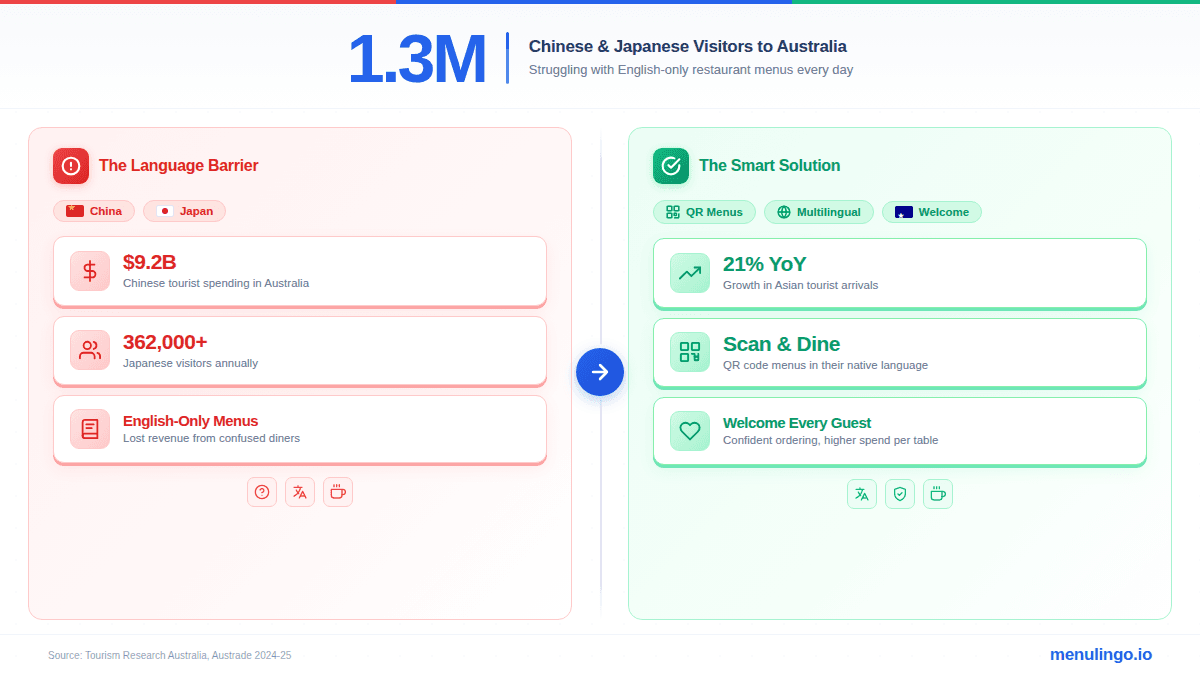
Australia is one of the most popular destinations in the Asia-Pacific for Chinese and Japanese travellers. In 2024, approximately 891,000 Chinese visitors and over 362,000 Japanese visitors arrived on Australian shores — a combined 1.25 million people, and those numbers are climbing fast.
Chinese arrivals grew 21% year-on-year. Japanese arrivals grew 33%. China remains Australia's second-largest source market by visitor numbers and the largest by spending, with Chinese tourists contributing a staggering $9.2 billion to the Australian economy in the year to March 2025.
These aren't backpackers on a shoestring. Chinese visitors spent an average of $10,200 per person in 2024. They're eating out. They're exploring regional areas. And increasingly, they're independent travellers — not tour groups with a guide who translates everything.
So here's the question every restaurant owner in a tourism area should be asking: can these guests actually read your menu?
The Menu Is Where Hospitality Breaks Down
Picture this scenario. A couple walks into your restaurant. They're well-dressed, clearly ready for a good meal, and they've chosen your place from the street or a recommendation. They sit down, open the menu, and hit a wall.
The descriptions are in English. The dish names might be in Italian or French. There are no photos. The allergen information — if it exists at all — is buried in fine print they can't decipher.
What happens next? They might point at something random and hope for the best. They might ask the waiter, who's busy and speaks quickly. Or — more often than restaurant owners realise — they quietly leave. As we explored in Restaurant Revenue Lost to Language Barriers, guests who can't read your menu order conservatively, skip add-ons, and rarely return.
This isn't a rare edge case. Mandarin and Japanese are among the most linguistically distant languages from English, meaning even travellers with some English education struggle with menu-specific vocabulary — words like "jus," "confit," "roulade," or even "capsicum."
The Numbers Tell the Story
Let's put some context around the opportunity:
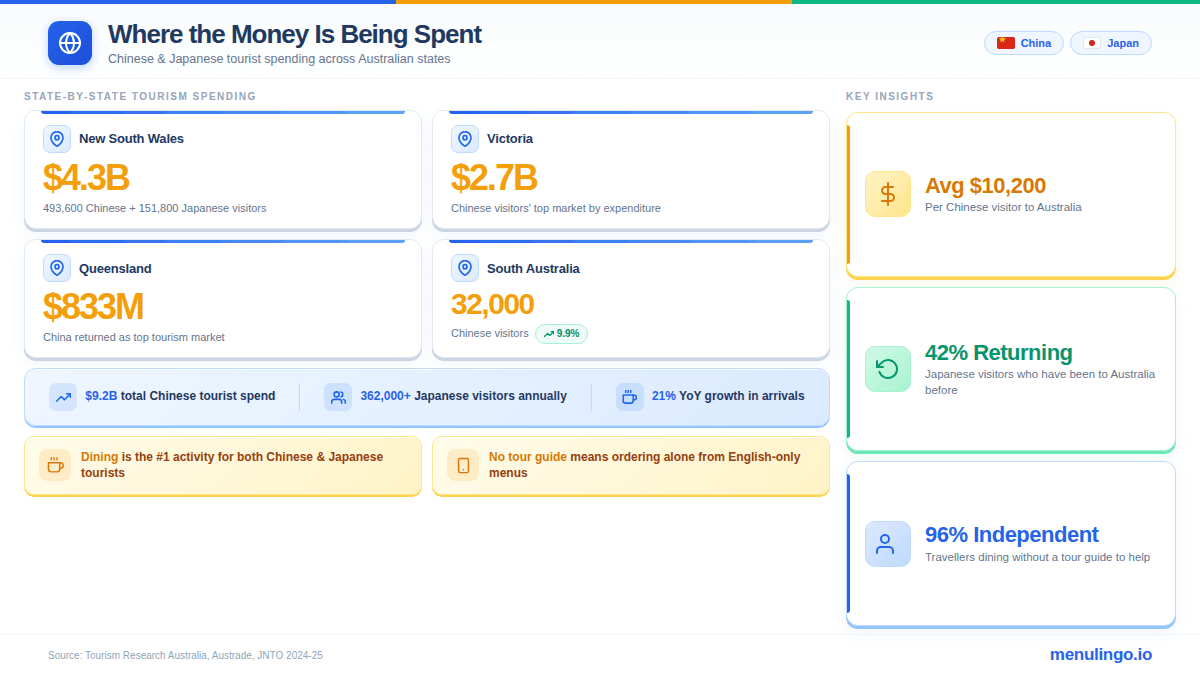
- China was Australia's top tourism market by expenditure in 2024, with visitors spending $7.89 billion nationally
- NSW alone welcomed 493,600 Chinese visitors who spent $4.3 billion
- Japanese visitors to NSW rose 24.8% to 151,800, contributing $496 million
- Queensland saw China return as its top tourism market by visitor expenditure at $833 million
- 42% of Japanese travellers to Australia in 2024 were returning visitors — they already know they like it here
And the trend is accelerating. Flight capacity from China exceeded pre-pandemic levels in January 2025. Australia was the number one long-haul destination for Chinese travellers during the 2025 Chinese New Year holiday. Tourism Australia expects China to resume its position as the leading source of international visitors in the near future.
Beyond Translation: The Allergen Problem
Language barriers don't just affect the dining experience — they create genuine safety risks. A guest who can't read your menu also can't identify allergens. As outlined in The Real Cost of Allergen Mistakes, a single incident costs far more than a returned meal.
Consider the complexity: a Chinese visitor with a shellfish allergy needs to know that your "seafood linguine" contains prawns, or that your "XO sauce" is made from dried shrimp. A Japanese guest avoiding dairy needs to understand that your risotto is finished with parmesan and butter — ingredients that might not be obvious from a menu description.
In Australia, food allergen disclosure requirements are tightening. Globally, regulations like the EU's FIC 1169/2011 and Natasha's Law have set a precedent that Australia is following. Providing allergen information only in English doesn't just leave international guests unprotected — it exposes your business to risk.
What Younger Travellers Expect
The demographic shift matters. Among Japanese visitors to Australia, 15-to-34-year-olds now make up the largest cohort at 64%. Chinese travellers in their 20s are the fastest-growing segment.
These younger visitors grew up with smartphones. They expect digital solutions. They're already using translation apps, QR codes, and digital menus in their home countries. When they scan a QR code at your table and get a menu in their own language — with allergen information clearly marked — that feels normal to them. When they get a paper menu in English with no digital option, that feels dated.
96% of Japanese tourists visiting Australia in 2024 were independent travellers, planning their own itineraries. They don't have a tour guide to translate. They're relying on whatever tools your restaurant provides — and as we covered in Why Google Translate Fails for Restaurant Menus, generic translation apps make serious errors with culinary terms and allergen terminology.
The Regional Opportunity
Here's a trend that makes this even more relevant: Chinese tourists are no longer sticking to Sydney and Melbourne. Tourism Australia has noted that visitors — even first-timers — are hiring cars and exploring regional areas. They're heading to the Barossa, the Great Ocean Road, the Daintree, and the Margaret River.
Regional restaurants often have the best food and the least infrastructure for international guests. If you're a restaurant owner in a regional tourism area, the wave of Chinese and Japanese travellers heading your way represents both an opportunity and a challenge. The restaurants that welcome these guests in their own language will earn their loyalty — and their reviews.
A Practical Path Forward
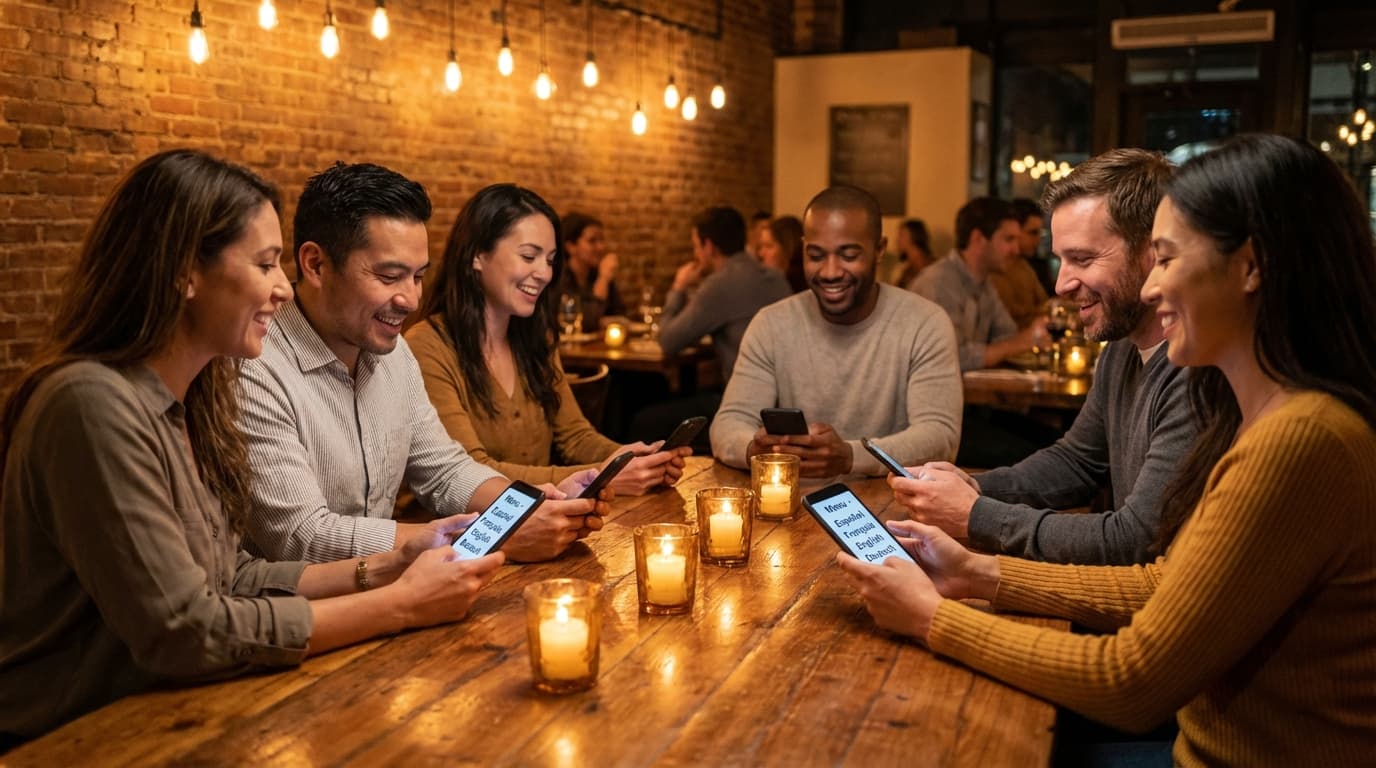
You don't need to hire multilingual staff or print menus in six languages. AI-powered menu translation solves this elegantly:
- QR code menus that detect the diner's language preference and display the full menu translated — not by Google Translate, but by AI trained on culinary vocabulary
- Allergen information presented clearly in the guest's own language, so they can filter for their specific dietary needs
- No app downloads required — the guest simply scans and reads
This is what MenuLingo was built for. One QR code on your table. 100 languages. Every allergen disclosed. Every guest welcomed.
For a restaurant with 40 menu items, the entire setup takes minutes. Your menu is parsed, allergens are detected, translations are generated, and your QR code is ready to print. When a Chinese tourist scans it, they see your menu in Simplified Chinese. When a Japanese couple scans it, they see it in Japanese. No apps, no friction, no guesswork. Here's a step-by-step guide to getting started.
The Bottom Line
1.3 million Chinese and Japanese visitors came to Australia in 2024. That number is growing by double digits every year. They're spending more per trip than almost any other visitor group. They're dining out regularly. And most of them struggle with English menus.
Every restaurant in a tourism area has a choice: leave those guests to fumble through your menu, or welcome them properly. The restaurants that choose hospitality over hope will capture a disproportionate share of the billions these visitors are spending.
Your menu should welcome every guest. Start your free trial and see how it works in minutes.
Ready to make your menu multilingual?
Join restaurants already serving diners in 9 languages with accurate allergen information. 14-day free trial, no credit card required.
Start Your Free Trial