EU FIC Regulation 1169/2011: Restaurant Allergen Compliance Guide
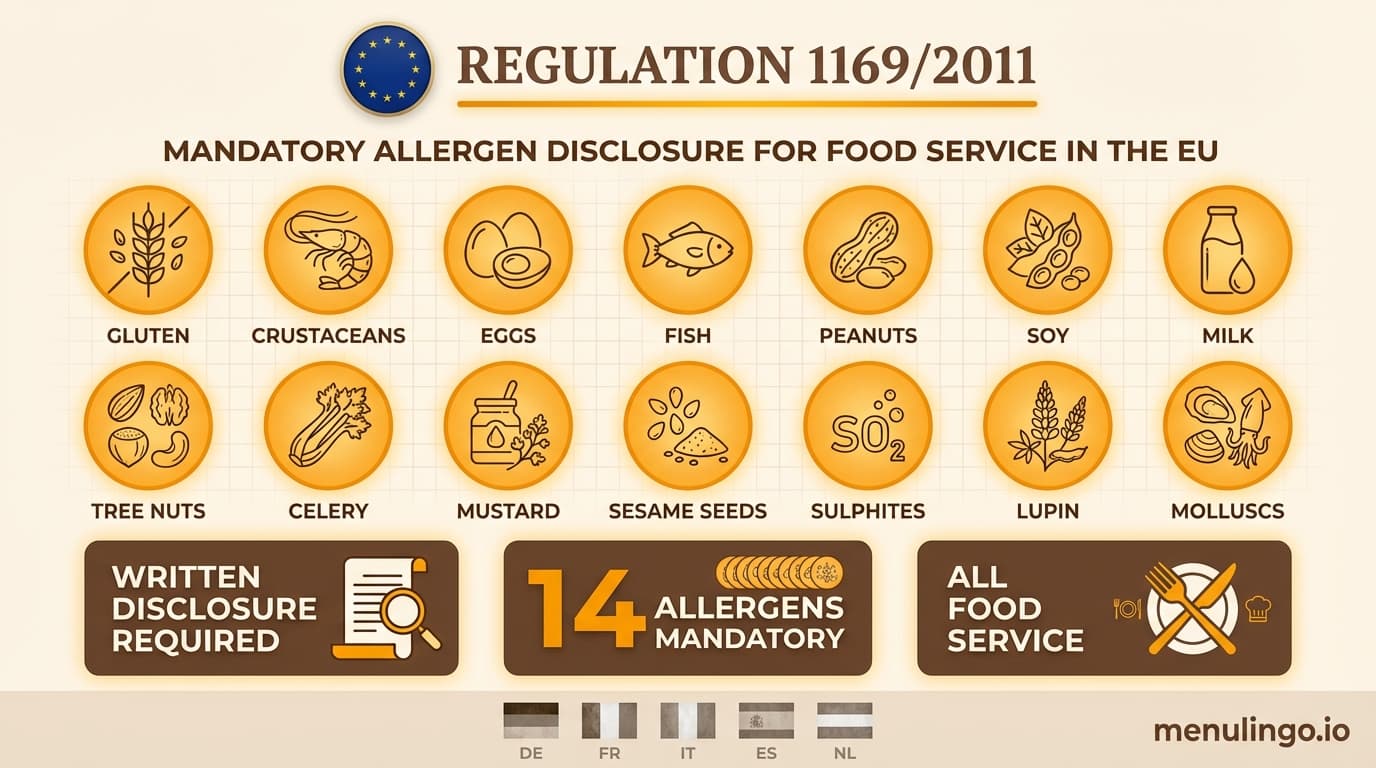
If you operate a restaurant, cafe, takeaway, or catering business anywhere in the European Union, you are legally required to provide allergen information for 14 major allergens. This isn't a recommendation. It's a binding requirement under EU Regulation 1169/2011 — the Food Information to Consumers (FIC) Regulation — and it has been in force since December 2014.
Despite being over a decade old, compliance gaps remain common across EU food service. Many restaurants still rely on verbal communication alone, unaware that this may not meet their national implementation of the regulation. Others declare allergens inconsistently or haven't updated their allergen information when recipes changed.
This guide breaks down what the EU allergen regulation requires, how individual member states enforce it differently, and what practical compliance looks like for restaurant operators in 2026.
What EU Regulation 1169/2011 Requires
The FIC Regulation is the EU's primary food information law. It covers all food sold to consumers, including food sold in restaurants and food service establishments. Chapter IV, Article 44 specifically addresses allergen information for non-prepacked foods — which includes most restaurant meals.
The 14 Mandatory Allergens
EU Regulation 1169/2011 requires disclosure of these 14 allergens (listed in Annex II):
- Cereals containing gluten — wheat, rye, barley, oats, spelt, kamut, and their hybridised strains
- Crustaceans and products thereof
- Eggs and products thereof
- Fish and products thereof
- Peanuts and products thereof
- Soybeans and products thereof
- Milk and products thereof (including lactose)
- Nuts — almonds, hazelnuts, walnuts, cashews, pecans, Brazil nuts, pistachios, macadamia nuts, and Queensland nuts
- Celery and products thereof
- Mustard and products thereof
- Sesame seeds and products thereof
- Sulphur dioxide and sulphites at concentrations above 10 mg/kg or 10 mg/litre (expressed as SO2)
- Lupin and products thereof
- Molluscs and products thereof
This is the same list used in UK allergen law (which inherited the EU framework) and closely aligns with Australia's FSANZ allergen requirements and the US FASTER Act list. For a detailed comparison of how these 14 allergens map across global frameworks, see our guide to the 16 major food allergens.
Written vs Verbal Disclosure
Article 44 of the regulation states that allergen information for non-prepacked foods must be provided to the consumer. The regulation itself allows member states to adopt national measures determining how this information is communicated.
This is where complexity arises. The EU regulation establishes the requirement but delegates the format to each member state. Some countries require written allergen information for every menu item. Others permit verbal communication with a written fallback. The specific rules depend on where your restaurant operates.
The general trajectory across the EU is clear: written allergen disclosure is becoming the standard. Countries that previously allowed verbal-only communication have progressively moved toward requiring written formats, and enforcement bodies increasingly expect documented allergen information during inspections.
How Different Member States Enforce the Regulation
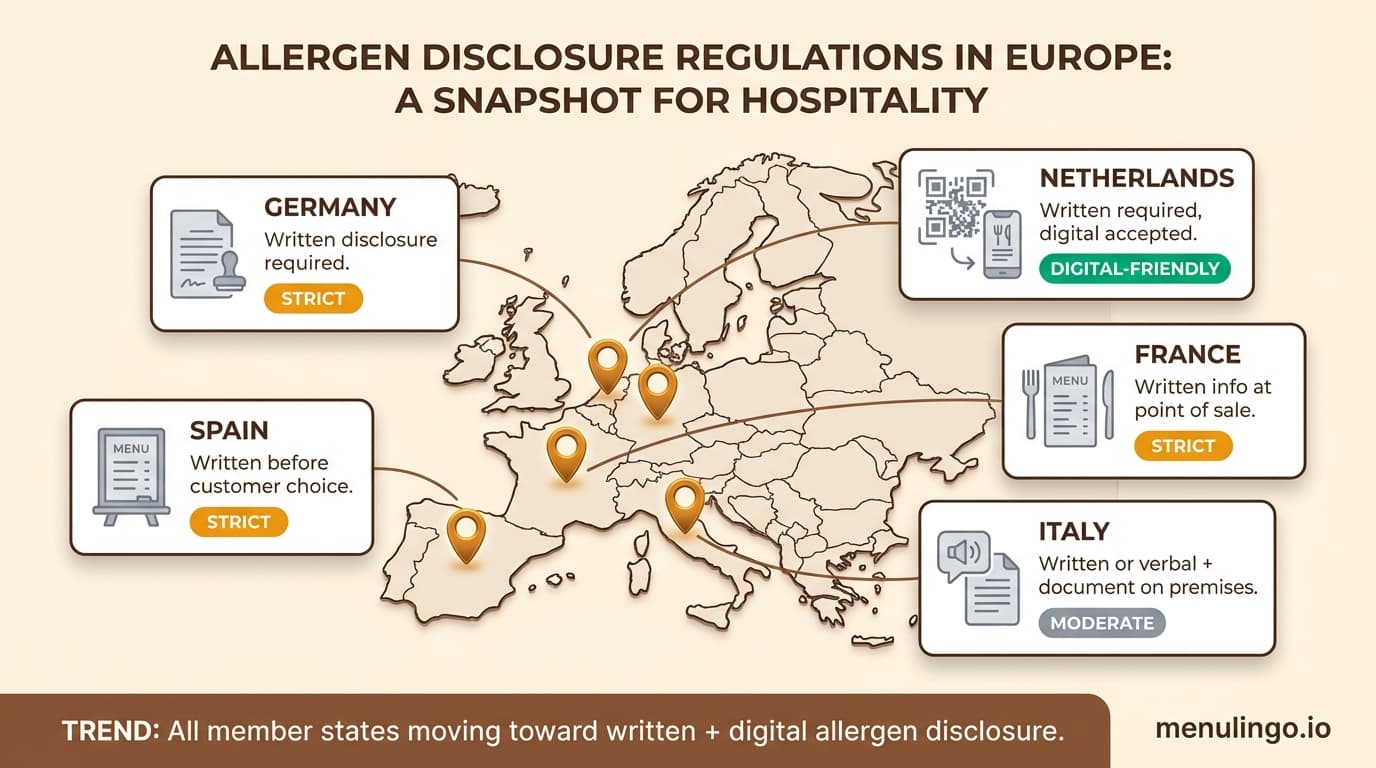
One of the most challenging aspects of EU allergen compliance for restaurants — particularly for groups operating across borders — is that enforcement varies significantly by country.
Germany
Germany requires that allergen information be available in writing. Restaurants must provide written allergen disclosure, either on the menu, on a separate allergen document, or via a clearly signposted system (such as a coded key on the menu referencing a separate allergen list). Verbal-only disclosure is not considered sufficient. Enforcement is handled by local food safety authorities (Lebensmittelüberwachung), and inspections routinely check allergen documentation.
France
France requires written allergen information to be available to consumers at the point of sale. For restaurants, this means allergen information must be accessible in writing — on the menu, displayed near the food, or available on request in a documented format. The DGCCRF (Direction générale de la concurrence, de la consommation et de la répression des fraudes) oversees enforcement.
Italy
Italy permits restaurants to provide allergen information either in writing on the menu or via a trained member of staff, provided that a written document with allergen details is available on the premises. Many Italian restaurants use a coded system on the menu (numbered footnotes referencing allergens) supported by a legend. Enforcement is through the ASL (Azienda Sanitaria Locale) during health inspections.
Spain
Spain requires allergen information to be available to consumers before they make their choice. For restaurants, this can be through written menus, signage, or a separate document. Many restaurants include allergen icons directly on the menu. The AESAN (Agencia Española de Seguridad Alimentaria y Nutrición) provides guidance, with enforcement by regional authorities.
The Netherlands
The Netherlands requires that allergen information for non-prepacked food be provided in writing. This can be on the menu, on a separate allergen card, or via an electronic system (tablet, QR code, website). Verbal communication alone is not sufficient. The NVWA (Nederlandse Voedsel- en Warenautoriteit) enforces food safety regulations.
Nordic Countries (Sweden, Denmark, Finland)
The Nordic countries generally require written allergen information to be available to consumers. Digital solutions, including QR codes linking to allergen information, are widely accepted and increasingly common. Enforcement is through national food safety agencies.
Summary Pattern
The direction across the EU is consistent: verbal-only allergen communication is being phased out. Written information — whether on menus, in separate documents, or via digital platforms — is either required or strongly recommended in virtually every member state. Restaurants that provide clear, written allergen information for all 14 allergens are compliant across the EU, regardless of which member state they operate in.
What Penalties Apply for Non-Compliance?
Penalties for failing to comply with allergen disclosure requirements under Regulation 1169/2011 vary by member state, but the framework allows for significant sanctions.
Administrative fines. Most member states impose fines for food information violations. In Germany, fines for food labelling offences can reach EUR 50,000. In France, DGCCRF penalties for consumer information violations can be substantial. In Italy, fines for food safety violations are set by regional regulations.
Enforcement notices. Food safety inspectors can issue formal improvement notices requiring restaurants to rectify allergen information failures within a specified period. Failure to comply with an improvement notice escalates the enforcement action.
Criminal liability. In cases where non-compliance results in a consumer suffering an allergic reaction — particularly a severe or fatal reaction — criminal liability can apply. Negligence in providing allergen information has been the basis for prosecution in several EU jurisdictions.
Insurance and civil claims. Beyond regulatory penalties, restaurants face civil liability if a diner suffers harm due to inaccurate or missing allergen information. The real cost of allergen mistakes includes legal defence costs, compensation, and reputational damage that can persist for years.
Inspection frequency. Restaurants with prior allergen compliance issues are often subject to increased inspection frequency. A clean compliance record reduces administrative burden; a history of violations increases it.
Common Compliance Gaps in EU Restaurants
After more than a decade of the FIC regulation being in force, certain compliance gaps remain stubbornly common:
"Ask Your Server" Without Written Backup
Some restaurants display a sign saying "Please ask your server about allergens" and consider this sufficient. In many member states, this no longer meets requirements. Even where verbal communication is technically permitted, the absence of written documentation creates risk during inspections and leaves no audit trail if an incident occurs.
Outdated Allergen Information
Allergen information created when the menu was last printed may not reflect current recipes. A change in bread supplier, a new brand of cooking oil, or a modified sauce recipe can introduce or remove allergens. If the written allergen information isn't updated when recipes change, it's inaccurate — and inaccurate allergen information is worse than none at all, because it creates false confidence.
Menu staleness is one of the most common compliance risks across all jurisdictions. Restaurants that update their menus seasonally but don't update their allergen documentation simultaneously are carrying unrecognised compliance risk.
Incomplete Allergen Coverage
Some restaurants declare allergens only for main dishes, ignoring starters, desserts, sides, sauces, and drinks. The regulation covers all food provided to consumers — not just the entrees. Bread served with olive oil, the house dressing on the salad, the garnish on the cocktail — each of these needs allergen assessment.
Language Limitations
The FIC regulation requires that food information be provided in a language "easily understood" by consumers. For restaurants in tourist-heavy areas — Paris, Barcelona, Rome, Amsterdam, Berlin — this creates a practical challenge. A French-only allergen document doesn't serve a Japanese tourist with a shellfish allergy.
While the regulation's language requirement primarily refers to the official language(s) of the member state, the principle of consumer understanding is clear. A restaurant that serves international tourists and provides allergen information only in the local language is technically compliant but practically failing a significant portion of its customers.
How Digital Menus Address EU Allergen Compliance
Digital menu platforms offer several specific advantages for meeting EU allergen regulation requirements.
Written Disclosure That Updates Instantly
A digital menu provides written allergen information for every item — meeting the requirement in every EU member state. When a recipe changes, the allergen information updates immediately. No reprinting delay, no lag between the kitchen and the customer-facing document.
Multilingual Allergen Information
Multilingual digital menus display allergen information in the diner's language. A German restaurant can provide allergen details in German, English, French, Spanish, Chinese, Japanese, Arabic, and dozens more languages simultaneously — from a single QR code at the table.
This directly addresses the FIC regulation's principle of consumer comprehension. A diner who reads allergen information in their own language is far more likely to make safe ordering decisions than one who's trying to interpret allergen codes in an unfamiliar language.
AI-Powered Allergen Detection
AI allergen detection analyses menu descriptions and flags potential allergens — including hidden allergens in compound ingredients. This catches allergens that manual review often misses: the milk in the breadcrumb coating, the celery in the stock, the mustard in the vinaigrette.
The restaurant owner reviews and confirms each detected allergen before it appears on the diner-facing menu. This creates an audit trail: the AI detected it, the owner confirmed it, the diner saw it. That's a robust compliance chain.
Client-Side Allergen Filtering
Diner-side allergen filtering lets customers select their allergens and see only safe dishes. This filtering happens entirely on the diner's device — no health data is transmitted to any server. This approach meets GDPR requirements (particularly relevant in the EU) while giving diners practical control over their allergen safety.
Compliance Documentation
Digital platforms can log when allergen information was last reviewed, who reviewed it, and what changes were made. This documentation is valuable during food safety inspections, where inspectors increasingly ask not just whether allergen information exists, but when it was last verified.
EU Allergen Compliance Compared to Other Jurisdictions
The EU's allergen framework is among the most comprehensive globally, but other jurisdictions are catching up.
United Kingdom. The UK retained the EU's 14-allergen framework after Brexit. Natasha's Law expanded requirements for prepacked-for-direct-sale food, and the FSA's 2025 guidance update recommends written allergen information for all food businesses — moving closer to the EU's written-disclosure standard.
United States. US allergen regulation has historically been less prescriptive for restaurants than the EU. However, California's SB 68 marks a significant shift, requiring menu-based allergen disclosure in chain restaurants from July 2026. The federal FASTER Act added sesame as the ninth major allergen in 2023.
Australia. FSANZ allergen requirements cover the same general territory as the EU, with the PEAL (Plain English Allergen Labelling) reforms completed in February 2026 improving labelling clarity.
For a full comparison, see our worldwide allergen regulations guide.
The EU's head start on written allergen disclosure means that restaurants operating in Europe are already expected to have robust allergen documentation. For multi-location restaurant groups operating across the EU and beyond, a consistent digital platform that meets the highest standard (the EU's written disclosure requirement) automatically satisfies requirements in less prescriptive jurisdictions.
Practical Steps for EU Restaurant Allergen Compliance
Whether you're opening a new restaurant in the EU or auditing an existing operation, these steps establish a solid compliance foundation:
1. Map your regulatory requirements. Identify which member state(s) you operate in and check the specific national implementation of the FIC regulation. Your local food safety authority's website will have guidance documents specific to your country.
2. Audit every menu item. Go through every dish, side, sauce, garnish, bread, dessert, and drink against the 14 allergens. Don't overlook compound ingredients — check with suppliers for processed items like stocks, sauces, and bread.
3. Document allergen information in writing. Whether on menus, in a separate document, or via a digital platform, ensure allergen information is available to diners in writing before they order. This meets requirements across all EU member states.
4. Establish an update process. Create a workflow that triggers allergen review whenever a recipe changes, a supplier changes, or a new dish is added. A digital platform with built-in review prompts is the most reliable approach.
5. Train your staff. Even with written allergen information, staff need training on allergen severity, cross-contamination prevention, and how to respond when a diner discloses an allergy.
6. Consider multilingual provision. If your restaurant serves international diners — and most restaurants in EU tourism centres do — providing allergen information in multiple languages goes beyond compliance to genuine customer safety.
Getting Started with Digital Allergen Compliance
EU Regulation 1169/2011 set the standard for allergen disclosure in food service over a decade ago. The trend since then has been consistent: more documentation, more enforcement, higher expectations. Restaurants that treat allergen compliance as a core operational practice — not a regulatory checkbox — are better positioned for both safety and business success.
MenuLingo provides digital menus with AI allergen detection, multilingual display in 100+ languages, and client-side allergen filtering — designed for exactly this compliance challenge. Plans start at $19.99/month. View pricing or start your free trial.
Ready to make your menu multilingual?
Join restaurants already serving diners in 9 languages with accurate allergen information. 14-day free trial, no credit card required.
Start Your Free Trial