Natasha's Law Compliance for Restaurants: What You Need to Know
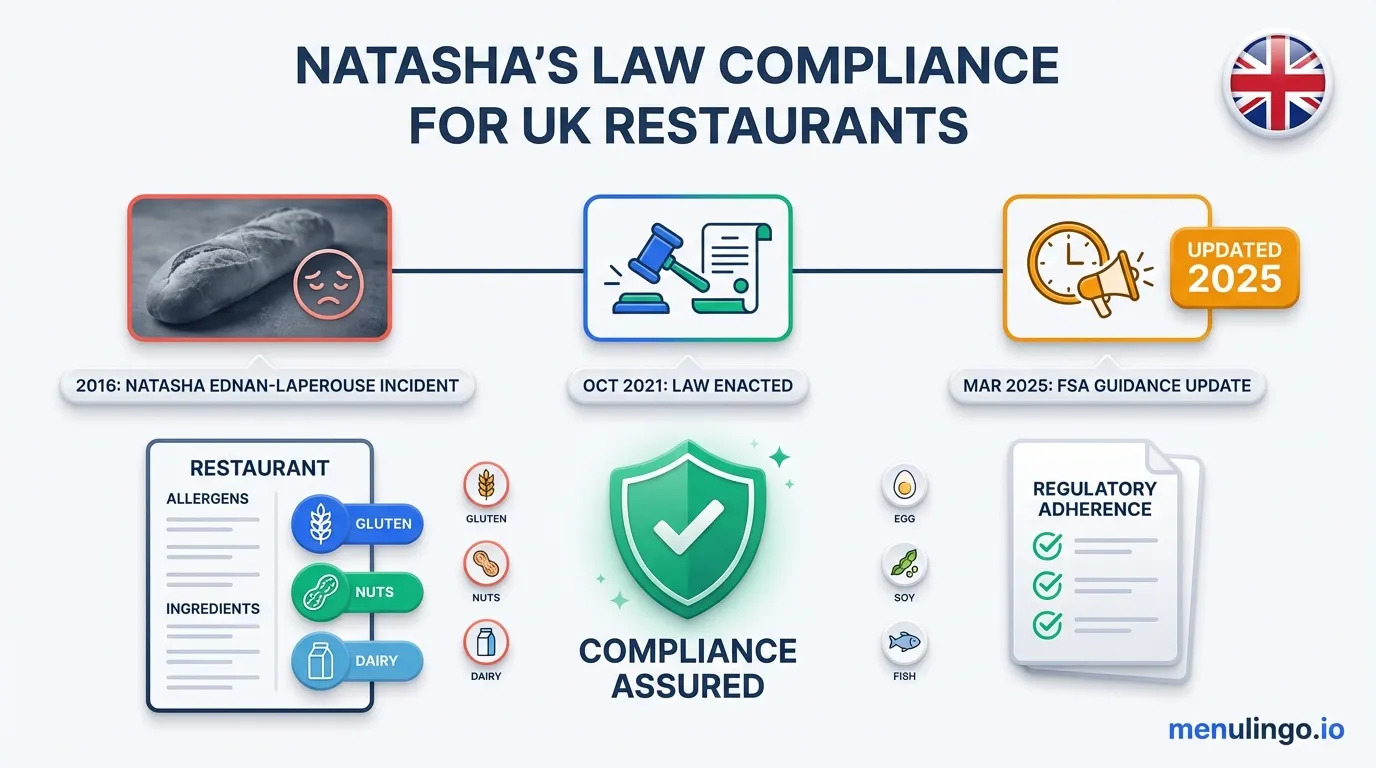
On 17 July 2016, fifteen-year-old Natasha Ednan-Laperouse bought a baguette from Pret A Manger at Heathrow Airport. The baguette contained sesame, which was baked into the dough but not listed on the label. Natasha, who had a severe sesame allergy, suffered a fatal anaphylactic reaction on the flight.
Her death exposed a critical gap in UK food labelling law. Foods prepared on the premises and packaged for direct sale — known as "prepacked for direct sale" or PPDS — had no requirement to list ingredients or allergens. The packaging looked like a finished product, but carried none of the allergen warnings that factory-packaged food required.
Natasha's Law was the direct result. It changed how the UK handles food allergen information, and its impact is still expanding.
What Is Natasha's Law?
Natasha's Law — formally the UK Food Information Amendment — came into force on 1 October 2021. It requires all food that is prepacked for direct sale (PPDS) to carry a label listing the full ingredients, with the 14 major allergens emphasised in bold, italics, or a different colour.
PPDS covers food that is prepared and packaged on the same premises where it's sold, before a customer selects or orders it. Think sandwiches in a café display, salads wrapped in a deli counter, or bakery items sealed in bags. These items look like packaged products but were made in-house.
Before Natasha's Law, businesses selling PPDS food had no legal obligation to provide written ingredient or allergen information. The assumption was that staff could answer questions verbally. In practice — as Natasha's case tragically demonstrated — verbal communication is unreliable, especially in busy food service environments.
The 14 Allergens Under UK Law
UK allergen law requires disclosure of 14 major allergens. These are the same 14 allergens specified under EU Regulation 1169/2011, which the UK retained after Brexit:
- Celery (including celeriac)
- Cereals containing gluten (wheat, rye, barley, oats, spelt, kamut)
- Crustaceans (crabs, lobster, prawns, scampi)
- Eggs
- Fish
- Lupin
- Milk (including lactose)
- Molluscs (mussels, oysters, squid, snails)
- Mustard
- Nuts (almonds, hazelnuts, walnuts, cashews, pecans, Brazil nuts, pistachios, macadamia)
- Peanuts
- Sesame
- Soybeans
- Sulphur dioxide and sulphites (at concentrations above 10mg/kg or 10mg/litre)
For a broader comparison including allergens required in other jurisdictions, see our guide to the 16 major allergens recognised across global food safety frameworks.
How Natasha's Law Evolved Beyond Prepacked Food
Natasha's Law itself only applies to PPDS foods. It does not, strictly speaking, apply to restaurant meals cooked to order, dishes served directly to diners, or food that is loose (unpackaged) at the point of sale.
However, the law triggered a broader shift in how the UK Food Standards Agency (FSA) approaches allergen information across the entire food service sector.
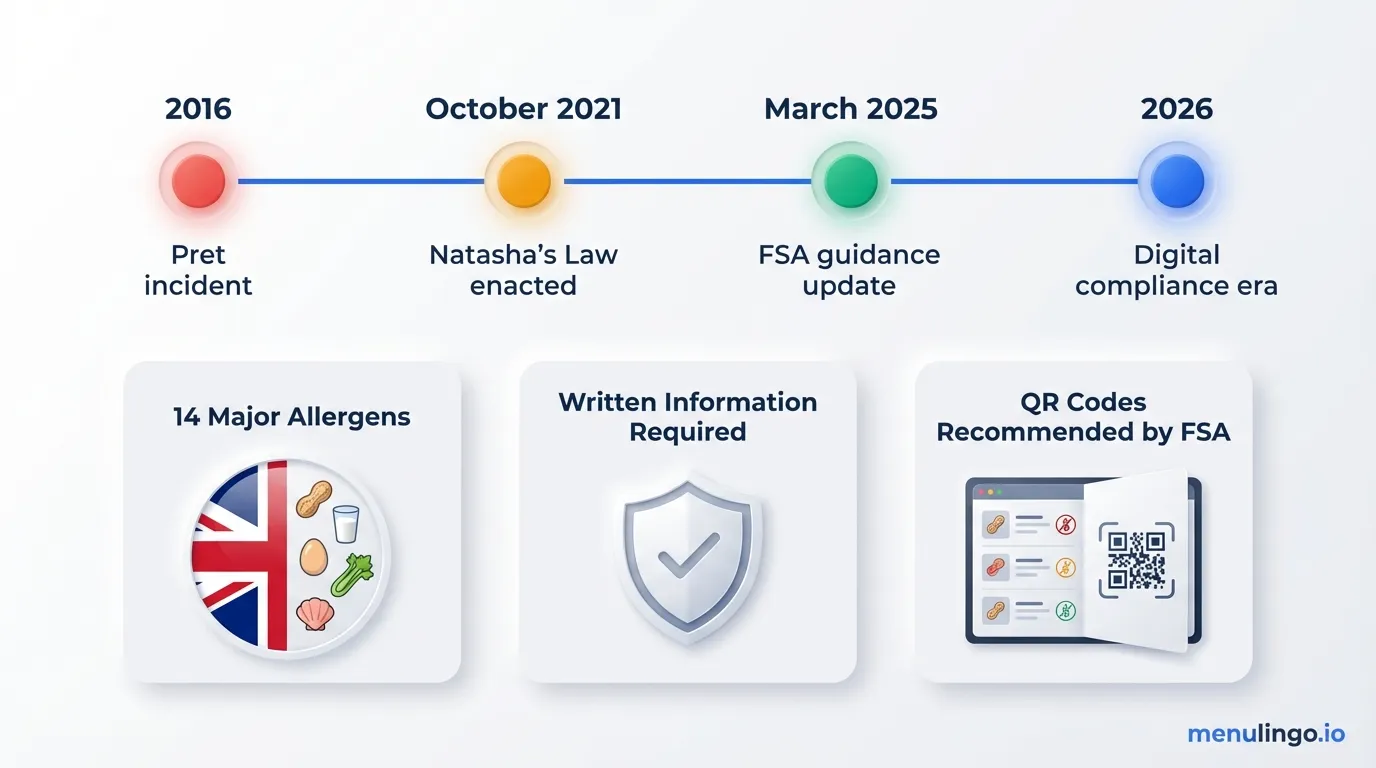
In March 2025, the FSA updated its guidance for the out-of-home food sector. This updated guidance made two significant changes.
First, the FSA now recommends that all food businesses — including restaurants, cafés, takeaways, and catering — provide written allergen information, not just verbal communication. While this is currently a recommendation rather than a legal requirement for non-PPDS food, it signals the direction of future regulation. Businesses that rely solely on "ask your server" are increasingly out of step with regulatory expectations.
Second, the FSA explicitly cited QR codes as an acceptable method for providing allergen information. This was a meaningful endorsement. It means a restaurant that offers a QR code linking to a digital menu with allergen information is meeting the FSA's recommended best practice — a strong position for compliance and risk management.
What UK Restaurants Must Do Now
The legal requirements and best-practice recommendations sit at two different levels. Understanding both matters.
The Legal Minimum
For restaurant meals that are not PPDS (that is, dishes cooked or assembled to order), the legal minimum under current UK law is:
- You must be able to provide allergen information for the 14 major allergens when asked by a customer.
- You must display a notice telling customers that allergen information is available — something like "Please speak to a member of staff about allergens."
- The information can be provided verbally, as long as staff are trained and able to give accurate answers.
For any food that is PPDS (pre-made sandwiches, packaged salads, wrapped bakery items), Natasha's Law applies in full: a label with complete ingredients and emphasised allergens is required.
Best Practice (FSA 2025 Guidance)
The FSA's updated guidance goes further than the legal minimum:
- Written allergen information is recommended for all menu items, including non-PPDS food.
- QR codes linking to allergen information are an approved delivery method.
- Regular allergen reviews should be conducted whenever recipes, suppliers, or ingredients change.
- Staff should be trained on allergen procedures — not just to answer questions, but to understand cross-contamination risks and the severity of allergic reactions.
The gap between the legal minimum and best practice is significant. Restaurants meeting only the minimum are compliant today, but they carry greater risk — both from a customer safety perspective and in terms of legal liability if an incident occurs.
How Allergen Information Can Be Provided
UK law and FSA guidance allow multiple methods for making allergen information available to customers. Each has tradeoffs.
Printed Menus with Allergen Symbols
Adding allergen symbols (small icons or codes) next to each dish on a printed menu. This is visible and immediate, but means reprinting menus whenever a recipe changes, and can make menus visually cluttered with 14 possible symbols per dish.
Separate Allergen Chart
A standalone document — often a laminated sheet or a binder — that lists every dish and its allergens. Available on request. This keeps the main menu clean, but relies on diners knowing to ask for it, and staff remembering to offer it. Separate charts also fall out of date when menus change.
Verbal Communication
Staff answer allergen questions in person. This is the legal minimum for non-PPDS food, but the FSA now explicitly recommends moving beyond verbal-only. Verbal communication depends on staff training, staff memory, shift handovers, and the accuracy of information passed from kitchen to front-of-house. In a busy service, mistakes happen.
Digital Menus via QR Code
Diners scan a QR code and access the menu on their device, with allergen information displayed per dish. The FSA explicitly approves this approach. Digital menus update instantly, can filter by allergen (so a diner with a nut allergy sees only safe dishes), and support multiple languages — useful for the UK's significant international tourist traffic.
For most restaurants, the strongest approach combines two methods: a digital menu (QR code) as the primary allergen information source, with staff trained to answer questions for diners who prefer not to use their phone.
Penalties for Non-Compliance
Enforcement of food allergen regulations in the UK falls to local authority environmental health officers. Penalties can include:
Improvement notices. A formal notice requiring the business to fix specific compliance failures within a set timeframe. This is the most common first step.
Fixed penalty notices. Fines issued for specific breaches. Amounts vary by local authority and severity.
Prosecution. For serious or repeated breaches — particularly where a customer has been harmed — criminal prosecution is possible under the Food Safety Act 1990. Convictions can result in unlimited fines and, in extreme cases, imprisonment.
Civil liability. Beyond regulatory penalties, a restaurant that fails to provide accurate allergen information faces civil claims if a customer suffers an allergic reaction. The real cost of allergen mistakes extends well beyond fines — it includes legal fees, compensation, insurance premium increases, and reputational damage.
Environmental health officers are increasingly focused on allergen compliance during routine inspections. The FSA's 2025 guidance gives officers a clearer benchmark to inspect against, even for non-PPDS food businesses.
How This Compares to Other Jurisdictions
The UK's approach to restaurant allergen compliance sits within a global trend of tightening requirements.
European Union. EU Regulation 1169/2011 has required written allergen disclosure for the same 14 allergens in all food service establishments since 2014. The EU requirement covers restaurants, cafés, takeaways, and catering regardless of business size. The UK's post-Brexit framework mirrors this but enforcement varies.
United States. There is no federal restaurant allergen disclosure law. However, California's new allergen law takes effect 1 July 2026, requiring chain restaurants with 20+ locations to identify nine major allergens on menus. Other states are expected to follow.
Australia. The Plain English Allergen Labelling (PEAL) transition completed in February 2026, improving allergen clarity on packaged food labels. Restaurant-specific allergen requirements vary by state but are trending toward stricter disclosure.
For a comprehensive comparison across jurisdictions, see our guide to worldwide allergen regulations.
The pattern is consistent: allergen disclosure requirements are expanding in scope (from packaged food to restaurants), in method (from verbal to written), and in enforcement (from voluntary guidance to mandatory law). Restaurants that prepare now avoid reactive scrambling when requirements tighten further.
Digital Solutions for Natasha's Law Compliance
A digital menu platform designed for allergen compliance addresses most of the practical challenges UK restaurants face.
Automatic allergen flagging. AI allergen detection analyses menu item descriptions and flags potential allergens — including hidden allergens in sauces, marinades, and compound ingredients that manual review often misses. Staff confirm each flag before it's visible to diners, combining AI thoroughness with human oversight.
Real-time updates. When a recipe changes, the allergen information updates immediately. No reprinting, no outdated separate charts, no lag between kitchen changes and front-of-house information.
Client-side allergen filtering. Diners select their allergens on their own device. The menu filters to show only safe dishes. This filtering happens entirely on the diner's phone — no health data is transmitted to any server, which matters for GDPR compliance.
Multilingual allergen information. UK restaurants serving international tourists can display allergen information in the diner's language. A Japanese tourist with a shellfish allergy can filter the menu in Japanese and understand exactly which dishes are safe. This is difficult to achieve with printed menus in any practical way.
Audit trail. Digital platforms log when allergen information was last reviewed and confirmed. This documentation is valuable during environmental health inspections and provides evidence of due diligence if a complaint arises.
For restaurants already thinking about compliance, our allergen compliance FAQ covers the most common questions, and our digital menu compliance checklist provides a step-by-step verification process.
Practical Next Steps for UK Restaurant Owners
1. Audit your current allergen process. How do you currently provide allergen information? Is it verbal only, printed, or digital? How confident are you that the information is accurate and up to date? Be honest — this audit is for you, not for an inspector.
2. Review every menu item against the 14 allergens. Go through your full menu with your head chef. Check every sauce, dressing, marinade, and garnish. Don't overlook items like bread (gluten, sesame, milk, eggs are common), stock (celery, fish), and desserts (nuts, eggs, milk, gluten). Document your findings.
3. Move beyond verbal-only. If you're currently relying on "ask your server," start planning a written alternative. The FSA recommends it, and it's almost certainly where the law is heading. QR codes linking to a digital menu with allergen information are the approach the FSA itself suggests.
4. Train your staff. Even with written allergen information available, staff need to understand allergen severity, cross-contamination risks, and how to respond when a diner discloses an allergy. Review our guide on staff allergen training gaps for common shortfalls.
5. Set a review schedule. Allergen information isn't a set-and-forget task. Every time a supplier changes, a recipe is modified, or a new dish is added, allergen information needs reviewing. Build this into your kitchen workflow — ideally with a digital system that prompts review rather than relying on memory.
6. Consider the bigger picture. Natasha's Law compliance for restaurants isn't just about avoiding penalties. It's about building a business that diners with allergies trust — and those diners are loyal, vocal, and growing in number. Food Standards Agency data suggests roughly 2 million people in the UK live with a diagnosed food allergy, with millions more managing intolerances. These diners actively seek out restaurants where they feel safe.
Moving Forward
Natasha's Law changed the UK's approach to food allergen safety. The FSA's 2025 guidance update makes it clear that the trajectory is toward written allergen information everywhere — not just on prepacked food. Restaurants that act now get ahead of future requirements, reduce their risk, and serve their customers better.
If you're looking for a practical way to provide allergen information that meets FSA guidance, works across languages, and updates as your menu changes, view MenuLingo pricing or start your free trial.
For a broader comparison of allergen laws across the UK, Australia, US, and EU, see our Restaurant Allergen Compliance Guide.
Ready to make your menu multilingual?
Join restaurants already serving diners in 9 languages with accurate allergen information. 14-day free trial, no credit card required.
Start Your Free Trial